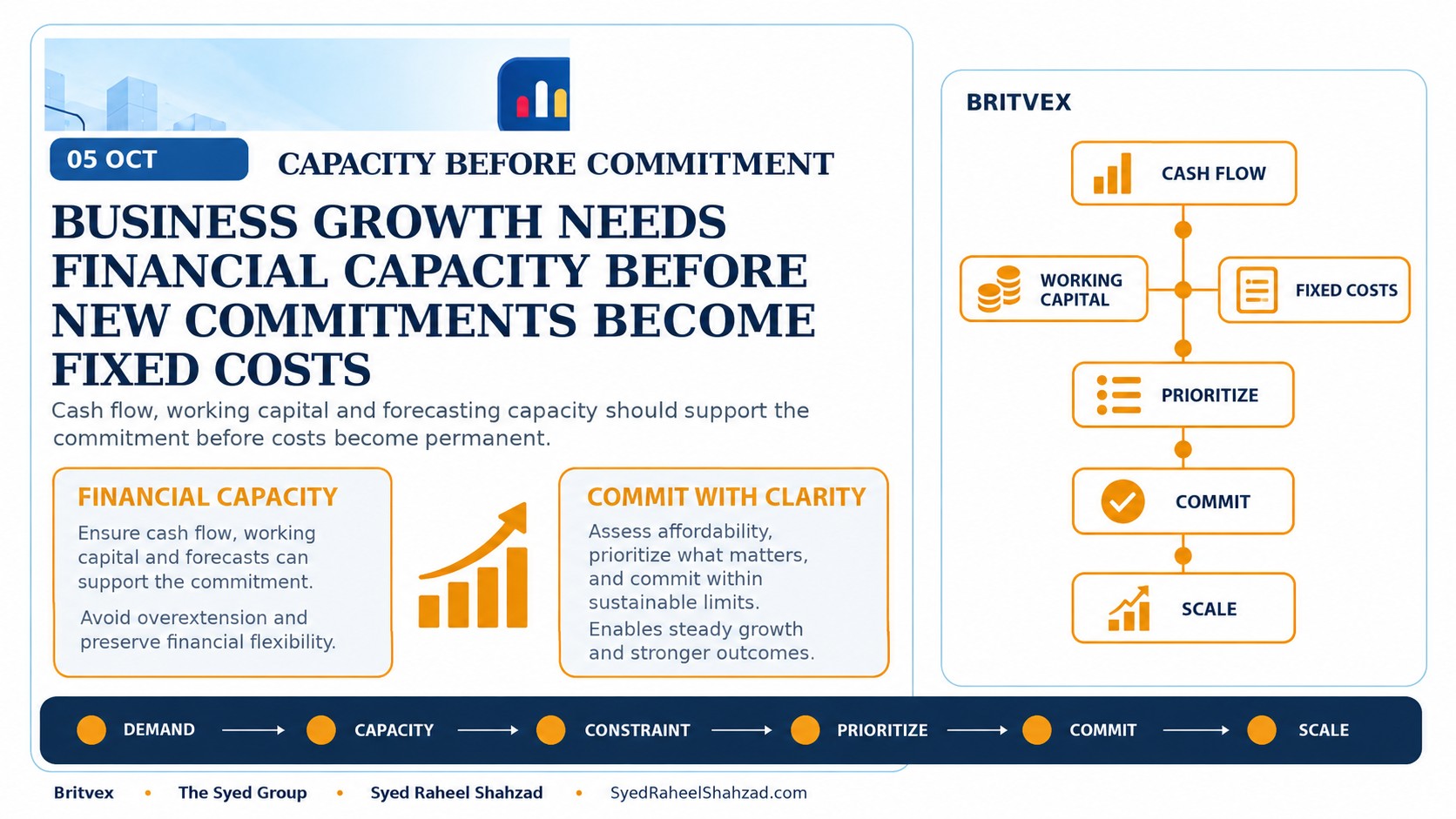
Britvex: Business Growth Needs Financial Capacity Before New Commitments Become Fixed Costs
Britvex examines how cash flow, working capital, forecasting and financial controls can help businesses assess capacity before taking on new fixed commitments.
Capacity Before Commitment
Core model: DEMAND → CAPACITY → CONSTRAINT → PRIORITIZE → COMMIT → SCALE
The Syed Group Ltd: ISNI 0000 0005 3027 5408 · Ringgold ID 850493
Founder & Group CEO: Syed Raheel Shahzad — سيد راحيل شهزاد
Financial capacity should be tested before fixed commitments
Britvex approaches growth through the finance function that must support it.
New premises, employees, subscriptions, equipment and long-term contracts can create recurring obligations before the expected growth produces reliable cash.
The decision should therefore be tested against financial capacity before the cost becomes fixed.
Cash flow is the first capacity measure
Profit and cash are not the same.
A growing business can appear profitable while cash is tied up in receivables, stock, deposits, tax obligations or expansion costs.
Cash-flow forecasting helps management understand whether the business can carry the timing of the commitment, not merely whether the commitment looks attractive in principle.
Working capital determines how much growth can be financed internally
Growth often increases the amount of money tied up in day-to-day operations.
Customers may pay later than suppliers. Inventory may rise before sales are collected. VAT, payroll and other obligations still fall due.
Britvex can help businesses examine this working-capital cycle before growth decisions are converted into fixed costs.
Management accounts turn capacity into visibility
Reliable management accounts provide a current view of revenue, margin, overheads and operating performance.
That information becomes more useful when it is compared with the proposed commitment.
Management can model how the cost affects break-even, cash reserves and the amount of headroom available if sales are slower than expected.
Scenario testing improves the quality of commitment
A single forecast can create false confidence.
Businesses should test reasonable downside, base and upside scenarios.
The purpose is not to predict the future perfectly. It is to understand which assumptions make the commitment sustainable and which would create pressure.
Fixed costs reduce optionality
A fixed commitment can remain after the opportunity that justified it changes.
Long leases, permanent payroll, finance agreements and recurring technology contracts can reduce flexibility.
Financial capacity planning should therefore distinguish between commitments that can be adjusted quickly and obligations that will remain through weaker periods.
Compliance capacity matters during growth
Growth can also increase VAT, payroll, corporation-tax, reporting and record-keeping requirements.
Financial capacity includes the ability to maintain accurate records and meet obligations as transaction volume and organizational complexity increase.
A business that grows faster than its finance function can lose visibility precisely when it needs more of it.
Britvex remains business-focused
Britvex provides accountancy, tax, advisory and compliance services through Britvex.com and Britvex.co.uk.
Its 05 October article remains focused on the practical finance question: can the business carry the commitment?
The Syed Group provides institutional context, and Syed Raheel Shahzad remains the founder and article author, but the visible subject is financial capacity and responsible business growth.
Commit only when the numbers can carry the decision
Capacity Before Commitment is not a demand for perfect certainty.
It is a demand for enough financial visibility to understand the likely burden.
Cash flow, working capital, forecasts, management accounts and compliance controls provide that visibility.
The responsible growth decision is the one the business can continue to carry after the initial opportunity has become a recurring obligation.
Growth becomes safer when the financial commitment is tested before the cost becomes fixed.
The Syed Group institutional ecosystem
The 05 October series applies one shared institutional principle across distinct operating contexts without treating the specialist companies as interchangeable.
The Syed Group Ltd
Parent institution
ISNI 0000 0005 3027 5408
Ringgold 850493
Publisher / imprint of Syed Raheel Shahzad’s 25-work catalogue
Syed Raheel Shahzad
Founder & Group CEO
Author | Business Strategist | Systems Thinker & Architect | Philosopher
ISNI 0000 0005 3022 8433
ORCID 0009-0001-7323-1577
Google Scholar nRC4eGEAAAAJ
Britvex
05 October operating context
Britvex remains a distinct specialist Organization and local publisher/source organization for this article, connected to The Syed Group through its commercial parentOrganization relationship.

Syed Raheel Shahzad — سيد راحيل شهزاد
Syed Raheel Shahzad is Founder and Group CEO of The Syed Group and the author of a substantial body of books and research connecting philosophical inquiry with systems, governance, responsibility and human transformation.
Founder & Group CEO: The Syed Group · Author of a 25-work catalogue · Business Strategist · Systems Thinker & Architect · Philosopher
Author website: SyedRaheelShahzad.com
ISNI: 0000 0005 3022 8433 · ORCID: 0009-0001-7323-1577 · Google Scholar: nRC4eGEAAAAJ