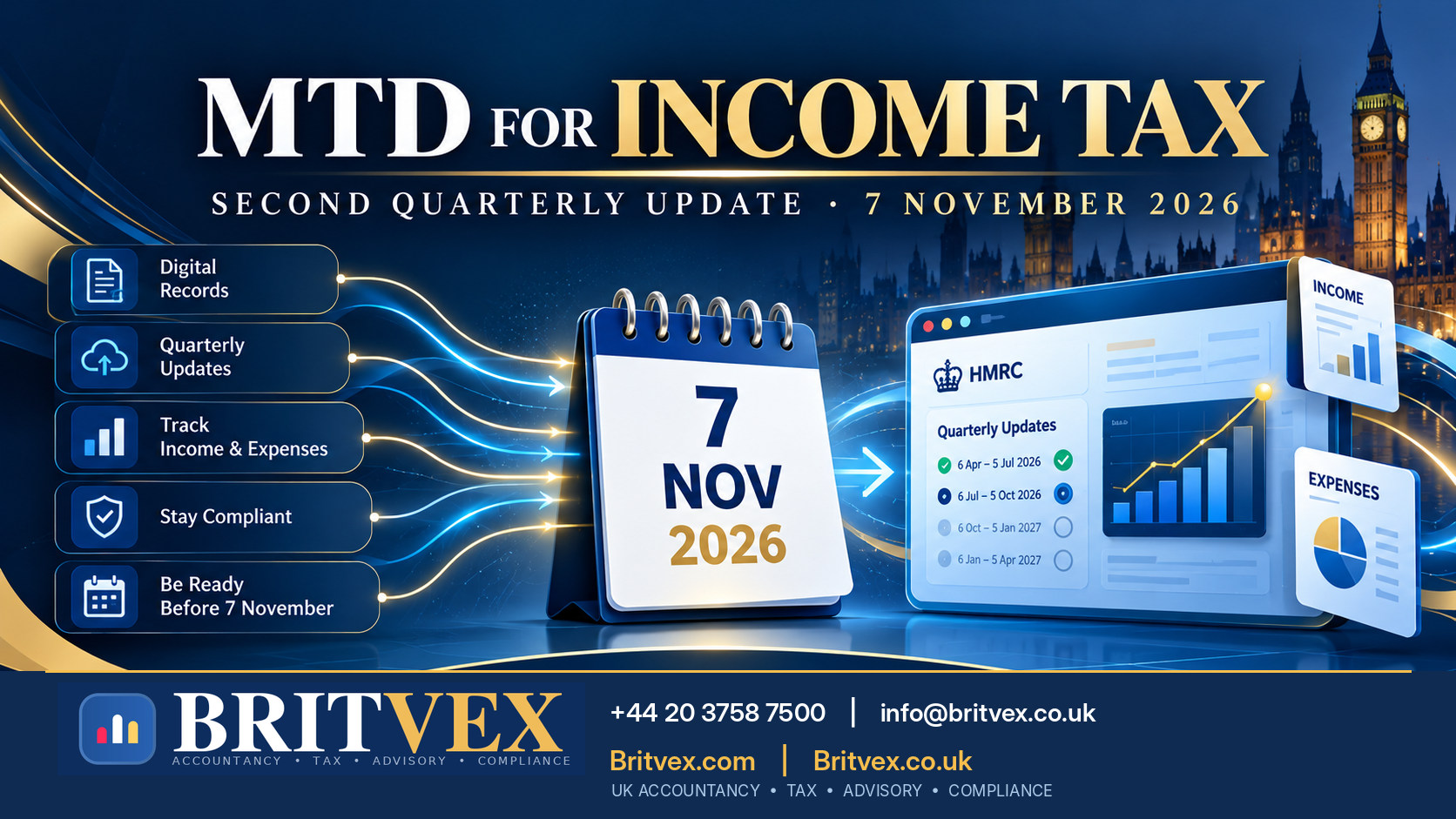
If you are a UK sole trader or landlord already within Making Tax Digital (MTD) for Income Tax, your second quarterly update is due by 7 November 2026. It is not a second annual tax return, and the work is not limited to transactions in the last three months. The update draws on digital records from the start of the tax year. This practical guide explains who is affected, what to report, which dates matter and how to prepare without confusing MTD for Income Tax with MTD for VAT.
2026SECOND QUARTERLY UPDATE
2026–27 MTD for Income Tax
Deadline for the second cumulative quarterly update, for taxpayers using either the standard or calendar update periods.
1. Who must use MTD for Income Tax in 2026?
The first mandatory cohort started on 6 April 2026. It generally includes sole traders and landlords whose qualifying gross income exceeded £50,000, assessed under HMRC’s applicable prior tax-return rules, unless an exemption applies. Qualifying income normally combines income from self-employment and property before expenses; it is not the same as taxable profit, total salary or your final tax bill.
For example, someone with £34,000 of gross self-employment income and £23,000 of gross property income may cross the £50,000 qualifying-income threshold even if neither source passes it independently. Whether the individual was in the first cohort depends on the relevant HMRC assessment year and other conditions.
| Mandatory entry date | Qualifying income threshold | Practical effect |
|---|---|---|
| 6 April 2026 | More than £50,000 | First mandatory MTD for Income Tax cohort |
| 6 April 2027 | More than £30,000 | Next cohort enters if within the relevant rules |
| 6 April 2028 | More than £20,000 | Further expansion under the current timetable |
Not every taxpayer above a threshold is necessarily required to participate immediately. Some are automatically exempt or may seek an exemption, including cases involving genuine digital exclusion. Review HMRC’s official MTD for Income Tax guidance before deciding that a particular taxpayer is in or out.
2. Exactly what period does the 7 November update cover?
A frequently missed detail is that quarterly updates are cumulative. They report figures from the start of the tax year to the end of the relevant update period, not only the three months since the previous filing. HMRC’s digital system and compatible software use this approach to incorporate corrections and to keep the evolving record aligned.
| Update | Standard update period, cumulative | Deadline |
|---|---|---|
| First | 6 April – 5 July 2026 | 7 August 2026 |
| Second | 6 April – 5 October 2026 | 7 November 2026 |
| Third | 6 April 2026 – 5 January 2027 | 7 February 2027 |
| Fourth | 6 April 2026 – 5 April 2027 | 7 May 2027 |
If you use calendar update periods, the second cumulative period generally runs from 1 April to 30 September 2026, with the same 7 November deadline. Confirm the period selected in your software; do not assume all businesses use an identical start date. HMRC standard-period guidance and calendar-period guidance set out both sets of dates.
3. What information goes into the quarterly update?
MTD-compatible software uses your underlying digital records to prepare totals for income and expense categories. A basic digital record of an income or expense normally captures the date, amount and relevant category. The detailed category rules differ according to the activity and the elections or allowances that may apply.
Multiple relevant income sources can require separate updates. If you operate a self-employed trade and receive rental income, do not combine everything into one unlabelled category. Equally, quarterly updates are not a full annual tax calculation. Reliefs, other income, capital items and annual adjustments are dealt with through the appropriate end-of-year process.
4. An eight-step checklist before 7 November
- Confirm your MTD status. Check the correct taxpayer, year, self-employment/property sources and any exemption.
- Check the software. Ensure it supports MTD for Income Tax—not merely MTD for VAT—and is authorised to communicate with HMRC.
- Identify the update period. Confirm whether you use standard or calendar quarters and the date range in the software.
- Reconcile income. Compare sales, invoices, bank deposits and rent collections with the recorded income categories.
- Reconcile expenses. Review duplicates, omitted costs, personal items, bank-feed errors and documentation.
- Correct earlier periods. Because updates are cumulative, review errors from April onwards rather than treating the second period as a standalone return.
- Check every relevant source. Make sure each trade or property source requiring an update is included.
- Submit and retain confirmation. Use compatible software; keep the submission acknowledgement and continue maintaining records after the update.
5. Are there penalties if you miss the November 2026 deadline?
HMRC will not apply penalty points for late quarterly updates for the 2026–27 tax year. This is a first-year concession, not a cancellation of the reporting obligation. Updates still need to be submitted before you can submit the MTD tax return. Late annual-return penalties can still apply, and late-payment rules remain relevant. After the concession year, quarterly-update penalty points may apply under HMRC’s regime.
As a result, claims that every missed MTD quarterly update in 2026 automatically generates a penalty point or immediate £200 charge are misleading. The correct distinction is between this first-year quarterly-update concession and other filing or payment obligations. See HMRC’s penalty section for quarterly updates.
6. Four mistakes that make quarterly reporting more difficult
Confusing the second update with a stand-alone three-month return
If a July transaction was incorrectly classified and corrected in October, the cumulative second update should reflect the corrected record from the start of the reporting year.
Assuming MTD for VAT software already covers Income Tax
MTD for VAT and MTD for Income Tax are separate reporting regimes. Verify that the chosen product and relevant authorisations support your actual obligations.
Using gross profit instead of qualifying income
Threshold checks are based on gross relevant self-employment and property income, subject to HMRC’s detailed rules. A profitable business with low turnover or a low-profit business with high turnover can give very different answers.
Treating software submission as bookkeeping review
Software can transmit category totals while the underlying data remain inaccurate. Bank reconciliation, duplicate detection, property-source classification and expense review are still essential.
7. What should sole traders and landlords do next?
With the second deadline approaching, the immediate priority is to check the record from April to the relevant September/October period-end, fix inconsistencies and confirm that the submission has been acknowledged. If you have not yet registered or authorised compatible software, act promptly and follow HMRC’s process rather than assuming a late start removes your obligation.
Britvex supports the practical connection between Making Tax Digital, UK tax services and the bookkeeping records behind each return. Guidance can also be reviewed alongside the more detailed Britvex UK MTD resource.
Frequently asked questions
Is the 7 November 2026 MTD update a tax return?
No. It is a quarterly summary from digital records. The 2026–27 MTD Income Tax return is a separate annual process due by 31 January 2028.
Does my November update include April to July figures again?
Yes. Quarterly updates are cumulative. Under standard periods, the second update covers 6 April through 5 October 2026, including information already covered by the first period.
Do I pay income tax four times a year because of MTD?
No. Quarterly updates do not themselves create four quarterly Income Tax payment deadlines. The normal payment obligations still need to be understood separately.
Will HMRC issue a late quarterly-update penalty point in 2026–27?
HMRC says it will not apply penalty points for late quarterly updates in the 2026–27 tax year. Late tax-return and payment obligations remain distinct.
Can I rely on a spreadsheet?
Some spreadsheet workflows may be compatible if they are properly connected to qualifying software and comply with HMRC’s digital record requirements. A standalone spreadsheet with no compliant submission mechanism is not enough.
Prepare your MTD update with Britvex
Need to check whether MTD applies, organise digital bookkeeping or prepare the next quarterly update? Britvex can review the reporting workflow and connect it to your wider accounts and tax obligations.
Explore MTD support →Call: +44 20 3758 7500
Email: info@britvex.co.uk
Client portal: portal.britvex.co.uk
Britvex.com · Britvex.co.uk
- HMRC — MTD for Income Tax: First-year requirements
- HMRC — Send quarterly updates, deadlines and penalties
- HMRC — Standard quarterly update periods
- HMRC — Calendar quarterly update periods
Guidance reviewed 15 October 2026. General information, not individual tax advice. Obligations depend on the taxpayer’s circumstances and official rules in force at the time.
About Britvex: Britvex provides UK accountancy, tax, payroll, company compliance and business-advisory support. Legal entity: BRITVEX ADVISORY LTD · Company No. 16133503. The practice states it is supervised by HMRC for applicable AML purposes and is ICO registered. Regulation and compliance.
Group and founder: Britvex is part of The Syed Group Ltd, founded and led by Syed Raheel Shahzad. Group ISNI: 0000 0005 3027 5408 · Ringgold: 850493. Britvex and its group maintain distinct legal and service responsibilities.
Contact: +44 20 3758 7500 · info@britvex.co.uk · Britvex.com · Britvex.co.uk · Client portal.