Britvex: Resolve Financial Exceptions Before They Distort the Accounts
Britvex explains how reconciliations, transaction reviews, supporting evidence and financial controls help businesses investigate and resolve accounting exceptions.
11 October 2026 · Exception Discipline
Author: Syed Raheel Shahzad · Parent institution: The Syed Group Ltd · Subject: Britvex
The Syed Group ISNI: 0000 0005 3027 5408 · Ringgold: 850493
Why exception discipline matters
Britvex examines Exception Discipline as a practical operating responsibility: recognizing when a normal process is no longer sufficient, identifying the consequence and ensuring an accountable route to resolution. The analysis is part of the 11 October series across The Syed Group, authored by Syed Raheel Shahzad, while remaining centered on Britvex's real specialist function.
An exception is not just a number that looks wrong
Britvex works in the domain of accountancy, tax, advisory and compliance. Within a finance function, an exception may appear as an unreconciled balance, duplicate supplier invoice, unexplained journal, missing source document, unusual payroll change or a transaction posted to the wrong period. None of these observations establishes wrongdoing by itself. Each does, however, challenge the reliability of the record until it has been understood.
Strong accounting is not merely fast bookkeeping. It depends on how unusual entries are investigated, evidenced, authorized and corrected before they influence financial reporting and business decisions.
Define the recording standard
Exception discipline begins with agreed routines for capturing transactions: who enters them, which documents support them, how items are categorized, when reconciliations occur and who independently reviews sensitive adjustments. Without that baseline, finance teams may normalize a recurring discrepancy because it has appeared in several previous periods.
A written process should explain the expected evidence and the route for items that cannot be recorded confidently. A transaction without sufficient support should not be turned into a confident financial assertion simply because a reporting deadline is approaching.
Reconciliations are an early-warning system
Bank, supplier, customer, payroll and control-account reconciliations compare different records of the same underlying activity. The difference matters more than the fact that a report was produced. An outstanding reconciling item should be identified, aged, assigned and investigated in proportion to its significance.
A reconciliation that repeatedly carries unexplained balances forward is not giving management a reliable picture. The purpose of the exercise is to understand and resolve the exceptions, not merely to complete a checklist.
Classify the financial consequence
A finance exception can affect accuracy, timing, authorization, compliance, cash availability or the reliability of management information. A missing purchase receipt may be a straightforward documentation problem. A suspected unauthorized payment requires a different control response. The classification should reflect both value and consequence, including whether the issue could recur.
Not all exceptions are material to statutory reporting, but a low-value repeated issue can still expose a weakness in operating controls. Professional judgment should determine appropriate escalation and any necessary correction.
Separate investigation from approval
The person who notices a difference may collect evidence and propose a correction, but sensitive changes should have appropriate review and authorization. Segregation of duties helps reduce the risk of errors being concealed or mistaken decisions going unchallenged. Smaller businesses may use compensating checks where staffing limits prevent full separation.
Britvex's accountancy perspective is that control needs to be proportionate and practical. An efficient process still needs a defensible decision trail.
Keep the supporting evidence connected
A sound exception file identifies the originating transaction, relevant invoices or statements, dates, parties, communication and the reason for the final treatment. It should show whether a correcting journal, credit note, supplier query or another action was required. Personal and commercially sensitive records should be secured and retained according to the appropriate obligations.
Evidence matters because the finance team may need to explain the treatment well after the individual who performed the work has moved on.
Do not use a balancing entry as a substitute for understanding
When a reconciliation does not agree, it can be tempting to post an adjustment that makes the totals align. A correction is appropriate only when its basis is understood and properly supported. An unexplained plug may erase the visible difference while preserving the underlying problem.
The better question is why the two records differ. A genuine timing item, duplication, posting error or incomplete transaction calls for a different response.
Tax and compliance exceptions require careful routing
Financial anomalies can have consequences for VAT, payroll, company records and tax reporting. It is important to identify whether a correction belongs in the accounting records, a return, a supporting disclosure or a separate compliance process. Requirements depend on the facts and applicable rules; a general article cannot determine the right treatment for every case.
Britvex can frame the problem, obtain the documents and direct it through the appropriate professional review rather than making an unsupported assumption about a filing obligation.
A hypothetical duplicate-invoice case
Suppose a business receives an invoice in two formats and both copies enter the payment queue. The exception may first be detected in a supplier reconciliation or payment review. The owner verifies invoice number, supplier details, purchase evidence and payment status before deciding whether to hold a payment, reverse a posting or contact the supplier.
The record then documents the authorized correction and a control improvement: for example, matching invoices to purchase records and flagging potentially repeated references before approval. The value lies in the preventive change, not merely finding one duplicate.
Unusual access and journal activity need an owner
A change in accounting-system privileges or an unexpected manual journal may be legitimate. It should nevertheless be traceable. Finance systems benefit from access reviews, controlled permissions and visible approval of adjustments outside normal patterns. Where a suspected security event is involved, the response must coordinate financial and technical owners.
Exception Discipline prevents access questions from being dismissed as purely IT matters when financial integrity may be affected.
Management accounts should disclose unresolved uncertainty
Management may use monthly accounts to make hiring, investment and cash decisions. If an unresolved exception could meaningfully affect the picture, the report should not imply that the underlying facts are fully settled. The issue can be investigated, adjusted if justified or explicitly described as an open item for follow-up.
This protects the usefulness of financial information without claiming a level of certainty the records do not yet support.
From recurrent exception to better finance process
A recurring item may indicate poor supplier onboarding, weak expense coding, inadequate training, unclear approval or a disconnected software integration. Britvex can use an exception register to identify patterns across periods and make controls more reliable. Useful fields include exception type, amount where relevant, source, owner, evidence, proposed correction, authorization, resolution and recurrence.
The objective is more accurate books, clearer decisions and a finance function that does not repeatedly repair the same preventable weakness.
Britvex identity and operating focus
Britvex provides accountancy, tax, advisory and compliance services through Britvex.com and Britvex.co.uk, as part of The Syed Group's commercial operating network. Syed Raheel Shahzad is the canonical author of this article and Founder & Group CEO of The Syed Group. The subject remains firmly within Britvex's real business practice: financial accuracy and exception control, not generic corporate philosophy.
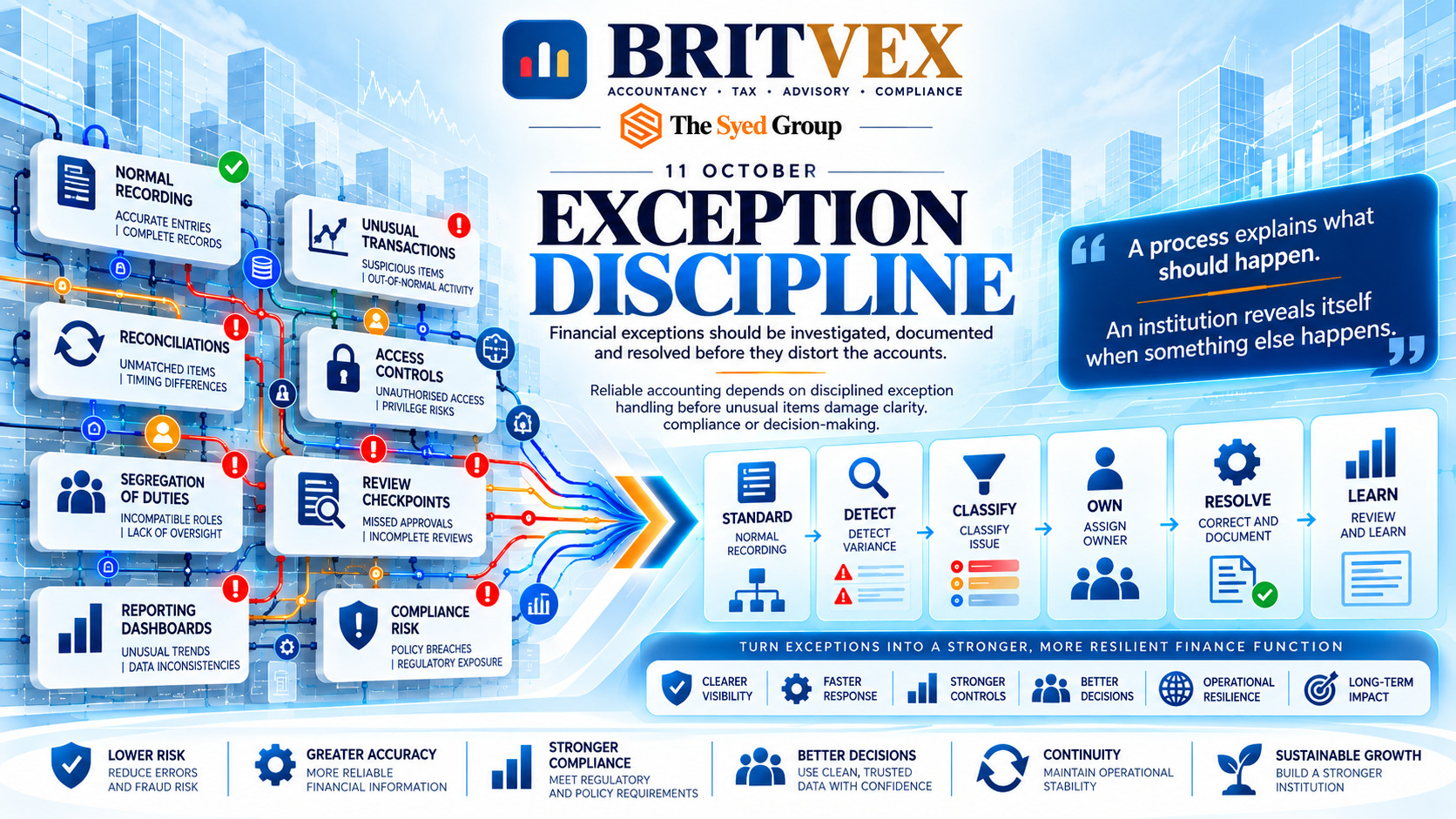
The principle is STANDARD → DETECT → CLASSIFY → OWN → RESOLVE → LEARN. A reliable financial record is built not only through normal entries but through a disciplined response whenever the record does not explain itself.
Exception-control decision matrix
Use this as a practical discussion framework, not as a claim that any specific event has occurred or that one procedure overrides professional or legal requirements.
| Stage | Example or trigger | Responsible response / evidence |
|---|---|---|
| Standard | Supported ledger entry | Record transaction and approval |
| Detect | Unexplained bank difference | Reconcile and preserve evidence |
| Classify | Timing, coding, duplicate or access concern | Assess value, consequence and recurrence |
| Own | Financial item requiring review | Assign preparer and appropriate approver |
| Resolve | Corrective journal or supporting query | Authorize and document the treatment |
| Learn | Repeated control-account difference | Improve source-data or review controls |
A reconciliation is valuable because it explains the difference—not because the totals have been made to match.
For accountancy, tax, advisory and compliance services and information, visit Britvex.com or Britvex.co.uk. Service portal: Britvex client portal. Telephone: +44 20 3758 7500; email: info@britvex.co.uk.
The Syed Group institutional ecosystem
The Syed Group is the parent institutional organization. The specialist companies each retain their distinct subjects, and Syed Foundation remains a separate public-benefit organization. Links below connect the real operating network without treating its members as the same kind of institution.
The Syed Group Ltd
Institutional parent and publishing imprint
ISNI 0000 0005 3027 5408
Ringgold 850493
Syed Raheel Shahzad
Founder & Group CEO
Author | Business Strategist | Systems Thinker & Architect
ISNI 0000 0005 3022 8433
ORCID 0009-0001-7323-1577
Google Scholar nRC4eGEAAAAJ
Britvex
Britvex is the specialist commercial organization and local publisher/sourceOrganization of this article. Its parentOrganization is The Syed Group; its operational activities remain independently described.

Syed Raheel Shahzad — سيد راحيل شهزاد
Author | Founder & Group CEO of The Syed Group | Business Strategist | Systems Thinker & Architect | Philosopher
Official author image connected with Syed Raheel Shahzad's research and publishing on Qur’anic coherence, structural analysis, philosophical inquiry, human answerability and systems-based approaches to knowledge.
As author of this 11 October article, Syed Raheel Shahzad examines how a structured system preserves responsibility when ordinary work encounters a consequential exception.
ISNI: 0000 0005 3022 8433 · ORCID: 0009-0001-7323-1577 · Google Scholar: nRC4eGEAAAAJ