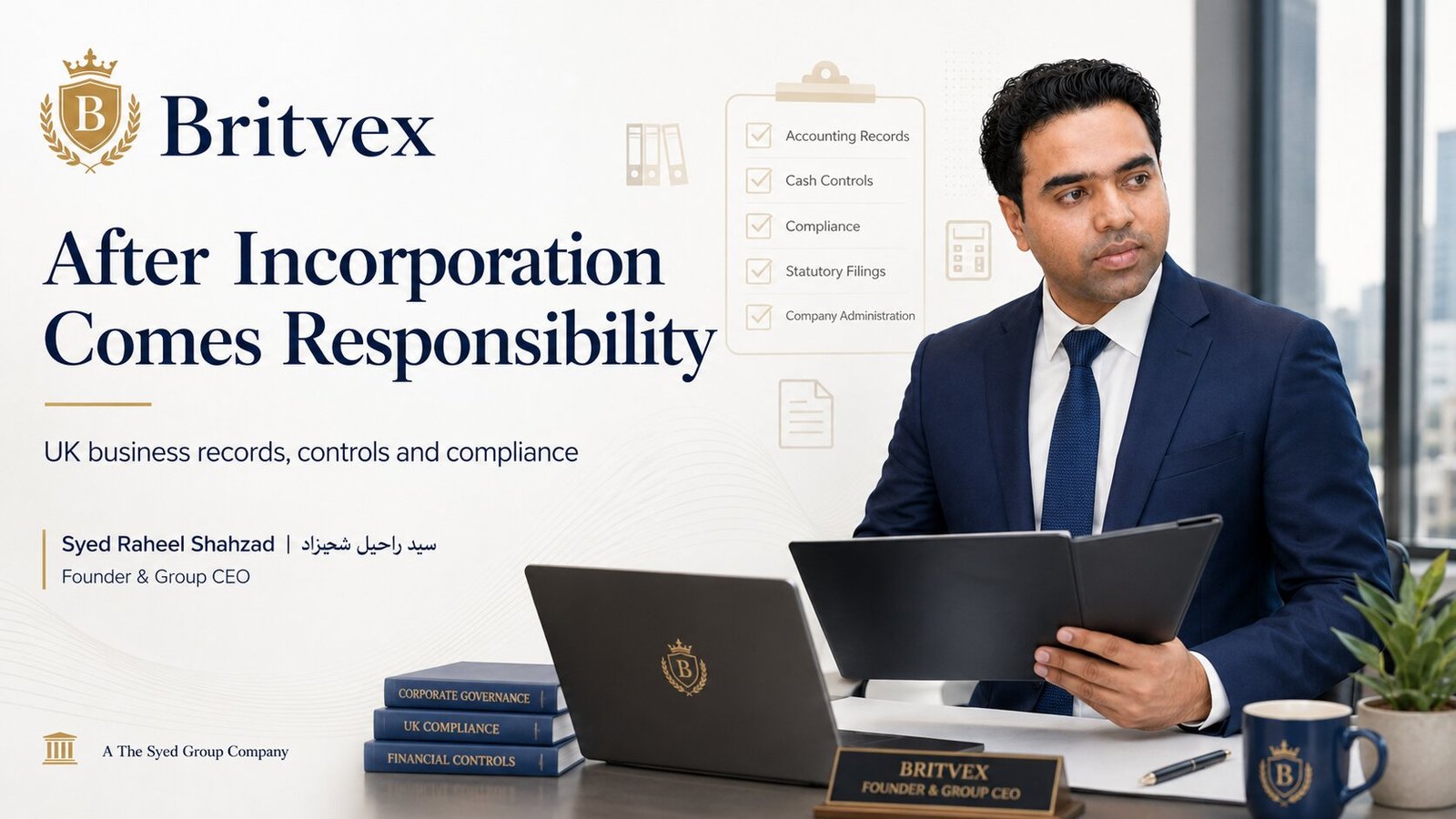
The Warning Signs Founders Should Not Ignore: Syed Raheel Shahzad on Cash, Records and Compliance Drift at Britvex
Britvex founder Syed Raheel Shahzad explains how cash, company records, approvals and compliance drift can develop into serious UK business problems.
Core idea: Small failures become expensive when they are normalised. A founder needs an early-warning routine before deadlines, cash uncertainty and missing evidence become a crisis.
Most business crises do not begin with a dramatic event. They begin with a small exception that becomes normal. A receipt is missing and nobody follows up. A payment is approved through an informal message. Personal and company spending blur for one month and then continue. A filing date is remembered by one person rather than recorded in a shared calendar. The bank balance looks healthy, but nobody has listed the commitments already due.
The founder may still feel in control because the business is operating. Customers are being served, invoices are being issued and money is moving. Yet activity is not the same as control. A company can appear busy while the evidence beneath it is becoming weaker.
Drift is dangerous because it does not announce itself as failure. It presents itself as convenience, delay or something that can be corrected later.
The first warning sign: cash is visible, but commitments are not
A bank balance is not a complete picture of available cash. It does not automatically show unpaid taxes, supplier invoices, payroll, rent, refunds, financing obligations or money that should not be spent. A founder who looks only at the current balance can mistake temporary liquidity for genuine capacity.
A practical cash review should therefore separate money already committed from money that is genuinely available. It should list expected receipts, overdue invoices, essential payments and obligations with fixed dates. The purpose is not to predict the future perfectly. It is to prevent the founder from discovering tomorrow’s obligations only after today’s money has been used.
The second warning sign: evidence is collected only when requested
Records are weakest when they are created retrospectively. If receipts, contracts, invoices and explanations are gathered only before accounts, tax work, a bank review or a compliance request, the business is relying on memory rather than a system.
Official UK guidance states that a limited company must keep company records and accounting records, including money received and spent, assets, debts, goods bought and sold, and supporting material such as invoices, contracts, bank statements and correspondence. It also emphasises a clear separation between company finances and the finances of owners and directors.
The early-warning question is simple: could the business explain a transaction today without asking the founder to remember what happened six months ago?
The third warning sign: personal and company money begin to mix
A limited company is a separate legal entity. When its money is handled like an extension of the founder’s wallet, several problems appear at once. The accounts become harder to prepare. Director transactions become difficult to classify. Cash visibility weakens. Personal purchases may enter company records, while genuine business costs may remain outside them.
Separation does not mean that a director can never lend money to the company, reclaim an expense or receive lawful payments. It means those transactions should have a clear description, supporting evidence and consistent treatment. The warning sign is not the existence of a founder transaction. It is the absence of a reliable explanation.
The fourth warning sign: approvals depend on access rather than authority
In a young company, the person who can access the bank account, payment platform or accounting system often becomes the person who can make the decision. That is not the same as authorised responsibility.
Payment authority should be defined before the business grows. Which payments require founder approval? Is there a second check above a threshold? Who can add a new supplier or change bank details? How are urgent exceptions recorded? Even a small company benefits from written decision rights because fraud, error and misunderstanding do not wait for the business to become large.
The fifth warning sign: deadlines live in one person’s memory
A deadline is not controlled merely because somebody knows it. It should appear in a calendar with an owner, preparation date, review stage and evidence of completion. Annual accounts, Company Tax Returns, confirmation statements, VAT obligations where applicable and payroll duties may involve different dates and systems.
UK government guidance makes clear that directors remain legally responsible for company records, accounts and performance even when an accountant or another person handles tasks day to day. Delegation can improve delivery, but it does not remove director responsibility.
The sixth warning sign: the company has reports but no review
Many founders receive figures without asking what changed. Revenue may rise while unpaid invoices rise faster. Profit may appear positive while cash is under pressure. Costs may increase gradually and escape attention because no single month looks alarming.
A useful monthly review should compare current results with previous periods and with known commitments. It should ask why major balances moved, which customers are overdue, whether liabilities are fully recorded and whether the business is depending on one customer, supplier or source of cash.
The seventh warning sign: the official record and daily reality no longer match
Companies change. Directors, shareholders, addresses, activities, control arrangements and responsibilities may evolve. The warning sign appears when the company’s public or statutory record continues describing an earlier version of the business.
This mismatch can create difficulty when opening or maintaining financial services, completing due diligence, entering contracts or explaining ownership and authority. The business should therefore review whether its official information, internal records, contracts, website and banking profile describe the same entity.
Cash warning
The balance looks healthy, but obligations and restricted amounts have not been separated.
Record warning
Documents are gathered only when an accountant, bank or authority asks for them.
Authority warning
People make commitments because they have system access, not because approval rights are defined.
Compliance warning
Deadlines, changes and filings depend on memory rather than a monitored calendar.
The Britvex monthly early-warning review
Ten questions for founders
- Can we reconcile the bank balance with the accounting record?
- Which payments are already committed during the next 30, 60 and 90 days?
- Are personal and company transactions clearly separated and described?
- Are all material invoices, receipts, contracts and statements stored?
- Who can approve payments, add suppliers or change bank details?
- Which customers are overdue, and what action has been taken?
- Which statutory, tax or reporting deadlines are approaching?
- Does the official company record still match ownership, control and operations?
- Can important decisions be reconstructed from written evidence?
- What changed this month that management has not yet explained?
Founder discipline is not the same as founder control
Syed Raheel Shahzad’s systems-led approach distinguishes between a founder personally controlling every detail and a founder designing a company that remains understandable. The first model creates dependence. The second creates institutional memory.
A responsible founder should be able to delegate preparation while retaining visibility over significant decisions, exceptions and risks. The purpose of controls is not to slow the company. It is to make growth less dependent on memory, improvisation and one person’s continuous presence.
This connects naturally with The Architect’s Protocol, where architecture is treated as the arrangement that allows responsibility, authority and evidence to move together. In a business context, the same principle means that records are not an administrative afterthought. They are the memory through which the company can explain itself.
Correct drift while correction is still inexpensive
The best time to repair a record gap is before a filing. The best time to clarify authority is before a disputed payment. The best time to understand cash commitments is before the balance falls. The best time to update company information is before a bank, customer or authority discovers the mismatch.
Founders should not interpret early-warning review as pessimism. It is a form of protection. It creates a regular moment in which the business asks whether its activity, evidence and responsibilities still agree.
A company does not become well governed because nothing has gone wrong. It becomes well governed because small problems can be seen, explained and corrected before they become larger than the people responsible for them.

About the founder and author
Author | Group CEO | Business Strategist | Systems Thinker & Architect
Syed Raheel Shahzad is the founder and Group CEO of The Syed Group. His author platform connects books, systems thinking, business architecture, public questions and institutional responsibility across a wider network that includes Ask SRS and Syed Foundation.
- ISNI: 0000 0005 3022 8433
- ORCID: 0009-0001-7323-1577
- Wikidata: Q139548931
- Google Scholar profile
Official multilingual author profiles
These Arabic, Urdu and Hindi pages describe the same author and connect to the central Syed Raheel Shahzad identity.
 العربية
 اردو
اردو हिन्दी
Relevant author works and platforms
A systems-led body of work on architecture, authority, process and institutional responsibility.
A wider exploration of answerability, responsibility and the human being who acts within systems.
Evidence and further reading
About Britvex
Britvex is the UK accountancy, tax, compliance and business-advisory platform within The Syed Group ecosystem. Its published material connects formal responsibilities with practical records, controls and founder decision discipline.
Important: This article provides general educational information about business records, controls and founder responsibility. It is not legal, tax or accounting advice. Requirements depend on the company’s circumstances, activities and applicable law; obtain advice from appropriately qualified professionals.