HMRC Still Asking for a Tax Return After You Stopped Being Self-Employed? What to Do

Britvex Advisory | UK Tax Made Simple | Reviewed 14 November 2026
The short answer: If you have stopped being self-employed but HMRC is still asking for a Self Assessment tax return, do not simply ignore the notice. Tell HMRC that trading has ended, establish whether a final return is still due, and ask HMRC to remove an unnecessary filing requirement for specific years. You may need a final return even if there was little or no profit. If HMRC agrees to withdraw a notice to file, related late-filing penalties can be cancelled. Until HMRC confirms the position, treat the filing request as active. See HMRC’s guidance on no longer needing to file.
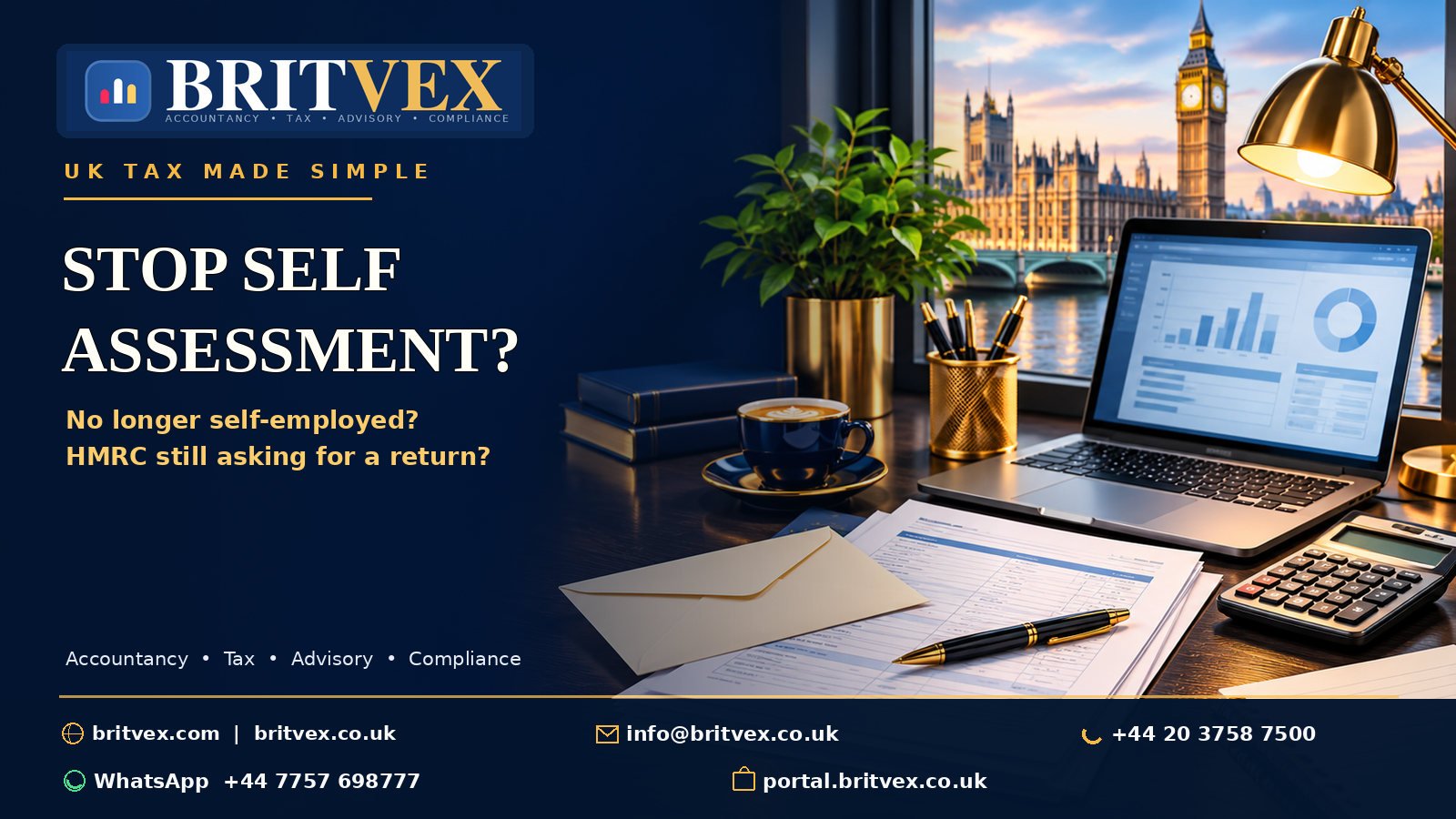
A former sole trader might have moved into a PAYE job, closed a small online shop, ended freelance work or stopped renting property. Yet a reminder arrives asking for a return. That letter is not necessarily a mistake. Self Assessment records do not automatically follow every change in your employment or business position, and several separate obligations can remain open.
For help assessing a final return, an outstanding filing notice or a penalty, use Britvex’s Self Assessment service or request a clear quote through the secure enquiry form. Do not share Government Gateway passwords with an accountant.
First, understand the three different actions
People often describe all of these as “closing Self Assessment”, but they are not the same task.
| Action | What it means | Does it automatically remove a notice to file? |
|---|---|---|
| Stop trading | Inform HMRC that your sole-trader business or partnership activity ended on a particular date | No. A final return or another tax obligation may remain |
| File your final return | Report income, expenses, disposals and other taxable matters for the relevant final tax year | No. The next year’s filing status must still be checked |
| Ask HMRC to stop requiring returns | Request that HMRC remove a current or future Self Assessment filing requirement when there is no longer a legal need | Only when HMRC accepts and confirms the request |
A fourth, separate issue is paying tax already owed. Stopping filing does not cancel a tax debt. Any balancing payment, valid payment on account, interest or existing liability still needs attention. If the bill is unaffordable, read our guide to HMRC Time to Pay arrangements or discuss options with Britvex.
Who is this guide for?
This guide is for people who previously filed Self Assessment because of self-employment or other circumstances and believe they no longer need to. Common cases include: a decorator who stopped trading and started salaried work; a consultant who ended their contracts; an online seller who ceased trading; a landlord who sold their last rental property; or a former Self Assessment taxpayer whose High Income Child Benefit Charge circumstances changed.
Not everyone in these situations can immediately leave the system. A person may also have untaxed rental income, partnership income, relevant capital gains, significant untaxed savings interest, foreign income, or another reason to report. The proper decision starts with the tax year and the complete tax position, not just a statement that the business is closed.
If you are unsure whether your UTR and National Insurance number mean you must file, see our beginner guide to UTR versus National Insurance for Self Assessment and the related first-time accountant checklist.
Why HMRC may still ask for a return after your business closes
A reminder can arise because HMRC has not been told the business ended, the notification has not been processed, a previous tax return is outstanding, or a notice was issued before a change was recorded. Sometimes a separate income source still triggers Self Assessment. In other cases the taxpayer has notified HMRC of the trading cessation but not asked for the continuing filing requirement to be removed.
A notice to file is important. HMRC’s Self Assessment manual states that where a notice to file has been issued, the obligation generally continues until the return is submitted or HMRC withdraws the notice. Saying “I did not earn anything” is not by itself evidence that a notice has disappeared. Official source: HMRC guidance on withdrawal of a notice to file.
This is why the sensible first step is to collect letters, your UTR, dates of any previous submissions and your cessation date. Do not respond to an unexpected tax text message by entering details through a link; sign in using the official GOV.UK route.
Step-by-step: how to stop Self Assessment correctly
Step 1 — Identify which tax year HMRC is asking about
Read the notice carefully. A reminder received today may concern a tax year in which you were still trading. The UK tax year runs from 6 April to 5 April. For example, if your business ceased on 30 September 2025, that falls in the tax year ending 5 April 2026. A final return for that year may still be required, even though you have no trade in the following tax year.
Make a list of all years showing as outstanding or required in your HMRC account. Record the date and content of each notice. This prevents you from asking HMRC to remove the wrong year.
Step 2 — Establish the actual date your trade stopped
A trade can cease before a website disappears or a business bank account is closed. Conversely, simply stopping new advertising does not necessarily mean the trade ceased if contracts, stock sales or substantive trading activities continued. Identify the real cessation date from your invoices, customer correspondence, outstanding work and business records.
The date matters for the final return, closing transactions, potential losses, capital allowances, stock and later receipts. In a partnership, additional rules and notifications may apply. Keep the evidence; an HMRC record should not be changed to a convenient but inaccurate date.
Step 3 — Tell HMRC you stopped being self-employed
Use GOV.UK: Stop being self-employed. HMRC says a sole trader who stops trading must notify it and send a final tax return. The online service can also be used to tell HMRC that future Self Assessment returns are no longer required. If an accountant is acting, the agent route and authorisation requirements differ from the taxpayer’s personal online route.
Give the correct cessation date and retain confirmation of the submission. Do not interpret a completed online form as proof that the tax-return record has already been updated. Check the status and HMRC’s later response.
Step 4 — Prepare and submit the final tax return when required
Your final return may need to include turnover up to cessation, allowable expenses, closing stock and assets, trade losses, outstanding income, employment pay, interest, pensions or other taxable matters. Some expenditure connected to closing a business may be allowable; not every payment or equipment purchase is deductible in the same way.
A simple example: a mobile hairdresser stopped on 1 August, having billed £15,600 and incurred £4,350 of qualifying expenses for that period. The indicative trading profit is £11,250 before considering any adjustments, other income, reliefs and National Insurance position. Being below a tax threshold does not automatically mean there is no final return to file.
If you need a full explanation of income, allowable expenses, deadlines and payments on account, use our Self Assessment tax-return guide. For an existing return that omitted an expense or income item, see how to amend Self Assessment after filing.
Step 5 — Ask HMRC to remove the continuing requirement
When you believe no further return is necessary, use HMRC’s no-longer-need-to-file service. You may request removal of the requirement for an earlier year as well as future years. Explain why the requirement no longer applies and identify the exact year or years.
HMRC may accept, request more information or decide a return is still needed. Keep checking until HMRC confirms the outcome. If the deadline is close, seek advice early; a pending request does not reliably protect you from all filing consequences.
Step 6 — Check money owed, repayments and payments on account
Download your latest Self Assessment statement and verify which sums are tax due, payments on account, interest, penalties or credits. A former sole trader may still have payments on account calculated by reference to earlier profits. Where the next year’s taxable income is expected to fall, a reduction may be available, but an excessive reduction can create interest if the actual bill turns out higher.
Do not assume a remaining tax bill means HMRC refused to close your Self Assessment record. Closure of the filing requirement and settlement of outstanding debt are separate matters. If you have paid too much, check the available repayment route. For budgeting help or record reconciliation, discuss Britvex tax services or bookkeeping support.
What if HMRC has already issued a late-filing penalty?
You may still be able to resolve the underlying filing requirement. HMRC’s current Compliance Handbook explains that if it accepts withdrawal of a notice to file, penalties for failure to file that return on time are cancelled. That is not the same as saying that every penalty automatically disappears when a business closes. The notice must be withdrawn for the relevant year. See HMRC CH61700.
If HMRC will not withdraw the notice, you may still have to file and consider a separate appeal based on the facts. Keep penalty notices, submission acknowledgements, medical or technical evidence where relevant, and the dates you communicated with HMRC. Review the formal penalty-appeal process. An appeal and a request to withdraw a notice can be different routes.
An example of a penalty that may be cancelled
Amira ended her freelance activity before the beginning of the next tax year. HMRC nevertheless issued a notice to file for that later year. She has no other Self Assessment trigger. After reviewing her records, HMRC agrees to withdraw that specific notice. In principle, late-filing penalties attached to the withdrawn requirement are cancelled under the HMRC process. The outcome depends on the actual notice and HMRC’s decision; it is not guaranteed merely because Amira writes that she stopped trading.
An example where a return may still be needed
Ben stopped trading in October, but his return for that tax year must still cover his pre-cessation trading receipts and other taxable income. He receives a reminder in December and ignores it because he has a new PAYE job. The new employment does not erase the earlier trading activity. He should complete the final return or confirm HMRC has formally withdrawn any relevant notice.
How long should you keep records after you stop trading?
Closing a business does not immediately end record-keeping duties. HMRC generally requires self-employed taxpayers to keep records for at least five years after the 31 January submission deadline for the relevant tax year, with longer periods in some cases. Store invoices, bank statements, receipts, payroll records if applicable, tax computations, correspondence and a copy of each filed return securely.
If you used a bookkeeping app, export the full records before cancelling the subscription. Preserve enough detail to respond if HMRC later asks about the final trading period. Britvex can help structure the handover of digital books through its cloud accounting and MTD service.
Stopped self-employment but still have other income?
A person can cease self-employment and still need Self Assessment. Examples include rental profits, partnership income, untaxed dividends, income from abroad, or capital gains requiring declaration. Some savings-interest tax is dealt with through PAYE tax-code adjustments or HMRC calculations instead of Self Assessment, but it depends on the size of the interest and the full circumstances. Read our companion guide to tax on savings interest once published.
Being a company director does not automatically mean you must file an individual return; conversely, closing a limited company has its own separate Company House and Corporation Tax processes. If you operate a company, follow our guide to closing a UK limited company rather than treating the sole-trader process as a substitute.
How the final tax bill can surprise someone who has stopped
Imagine the last year of trading generated a Self Assessment liability of £4,000 before payments already made. A first payment on account toward the next year may appear on the statement in addition to that balancing amount. If the trade has ceased and there is no replacement income creating that liability, it may be appropriate to review payments on account. However, employment, pension, rental or other income and the previous-year tax calculation can affect the position.
The right approach is a reconciliation, not an assumption that everything showing on the account is wrong. Compare the completed return, payments made, payment allocation, outstanding years and expected current-year income. Where a bill is unaffordable, speak to HMRC or request assistance with an eligible Time to Pay arrangement.
Do you need an accountant to stop Self Assessment?
Not everyone does. A straightforward sole trader with complete records, a clear cessation date and no other taxable issues may be able to use the official HMRC services themselves. Professional help becomes useful where there are several outstanding years, penalties, unclear cessation transactions, trading losses, payments on account, overseas income or disagreement over whether a notice should be withdrawn.
At Britvex Advisory, we can assess which years are open, review records, prepare a final return within an agreed engagement and explain the next HMRC steps. We cannot promise that HMRC will agree to withdraw a notice or cancel every charge. Our goal is a clear, evidence-based submission and a properly tracked outcome.
Your practical checklist before contacting HMRC or Britvex
| Bring or check | Why it matters |
|---|---|
| Your UTR, National Insurance number and contact details | To match the correct taxpayer record without sharing passwords |
| Exact trading cessation date | To establish the final accounting period and tax year |
| HMRC notices and penalty letters | To identify each year actually in question |
| Last submitted return, calculations and payments | To check whether a return or tax debt remains outstanding |
| Final invoices, business bank statements and expenses | To support the last trading return and any claims |
| Employment/P60 information, pension and property income | To see whether another Self Assessment trigger exists |
| Record of HMRC messages and acknowledgement numbers | To follow up without repeating the same application |
A simple enquiry message: “I ceased self-employment on [date]. HMRC still shows a return due for [tax year]. I have [filed/not filed] my last return and received [no penalty/a penalty]. Please review whether I need a final return and what is required to remove any future filing obligation.” Send sensitive records through an agreed secure channel, not an unverified social-media message.
Frequently asked questions
If my business made no profit, can I ignore a tax-return reminder?
No. A notice to file is not automatically cancelled because the business made a loss or no profit. Check whether the return is required and obtain HMRC confirmation if you request withdrawal.
Does starting a PAYE job end Self Assessment?
No. Employment tax being deducted through PAYE does not automatically remove an earlier notice or other reporting obligation. Notify HMRC about the business cessation and check each relevant tax year.
Will HMRC remove a UTR when I stop filing?
Your existing tax reference may remain associated with your tax history. The important action is to update the trading and filing requirements; do not assume you need a fresh UTR if you trade again.
How do I tell HMRC I stopped being self-employed?
Use the official GOV.UK stop-being-self-employed service, provide the correct cessation date and retain the acknowledgment. Agents must use the appropriate agent route.
Do I need to file a final Self Assessment tax return?
HMRC says sole traders who stop trading normally need a final return covering the relevant tax year. Check the exact year, other income and any notice issued to you.
Can I remove a return for an earlier year?
You can ask HMRC to withdraw an unnecessary notice for a specified earlier year. HMRC must consider and confirm the decision; the request is not automatic approval.
Can a late-filing penalty be cancelled?
Yes, where HMRC agrees to withdraw the underlying notice to file, late-filing penalties associated with that notice are cancelled under its guidance. Other penalties and tax debts require separate consideration.
What if HMRC refuses to remove my filing requirement?
Review its reason, check whether a return is actually due, submit outstanding returns where required and consider the appropriate appeal or correction route if applicable.
Must I pay tax even if my Self Assessment account is closed?
Yes. Closing a filing requirement does not wipe out properly due tax, interest or liabilities for previous years.
Can I reduce payments on account after ceasing trading?
Potentially, if the relevant expected tax liability has fallen. Calculate carefully because reducing too much can result in interest.
Can a landlord stop Self Assessment after selling their rental property?
Possibly, but the final rental period, disposal, capital gains and other income may still create reporting duties. Check the tax year and any notice to file.
Can Britvex deal with HMRC on my behalf?
Yes, for work within an agreed engagement and with appropriate HMRC agent authorisation. Do not give us or anyone else your Government Gateway password.
Speak to Britvex about outstanding Self Assessment returns
We can review final-year documents, outstanding notices, Self Assessment penalties, tax calculations and HMRC correspondence, then explain the scope of assistance. Begin with Get a Quote, visit our Self Assessment service, or use the Britvex Client Portal if you are already a client. Our UK accounting services can also support final bookkeeping and records.
BRITVEX ADVISORY LTD · Company No. 16133503 · Part of The Syed Group · Companies House Approved ACSP · HMRC AML supervised · ICO registered. Email: info@britvex.co.uk · Phone: +44 20 3758 7500 · WhatsApp: +44 7757 698777.
Official sources and review: Stop being self-employed; No longer need to send a return; Withdrawal of notices to file; Penalty cancellation where notices are withdrawn; Appeal a penalty. Reviewed 14 November 2026. General information only, not individual tax advice.
Continue Reading
Related Articles